Monday, 21 March 2022

City of Gold

Black Swan/STC/Perth Festival


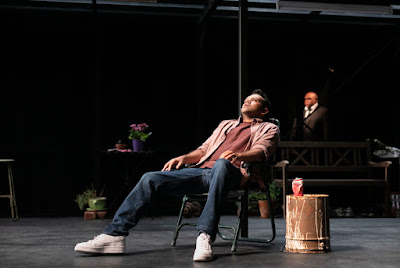
Actor/playwright Mayne Wyatt wrote City of Gold in response to the death of his father (an activist leader) in 2015 and the killing of Elijah Doughty (a relative) in Kalgoorlie the following year. The play had its premier season with a QTC/Griffin co-production in 2019. Since then it's been seared into the national consciousness – not least thanks to an appearance on Q&A in 2020 that included a devastating performance to camera of a key monologue about racism from the play. 


Meanwhile its significance has been underscored by the police killings of Kumanjayi Walker in the Northern Territory and George Floyd in the United States, as well as numerous other Black and Aboriginal deaths in custody, on the streets and in their homes. Just last week, the officer who shot and killed Walker was acquitted of all charges (no police officer in Australia has ever been convicted for the death of an Aboriginal person). The words ‘I can’t breathe’ are even uttered by one of the characters in City of Gold while he’s being knelt on by a policeman at the climax of the play. Wyatt's character in the play is named Breythe Black.


Now a new Black Swan/STC co-production directed by Shari Sebbens (who was in the cast of the original production) has finally opened at the Heath Ledger Theatre as part of Perth Festival for a foreshortened 10-day season, after delays due to Covid-related precautions. 


The term ‘foreshortening’ also describes the form and content of the play. As in Mantegna’s Lamentation over the Dead Christ, City of Gold deals with the aftermath of death in a way that is up close and personal, and the compression of perspective creates a dramatically heightened effect. This is intensified by the writer playing the lead role in a semi-autobiographical play focussing on a family in Kalgoorlie who are dealing with a double bereavement. The action is also compressed into several days, from the moment when Breythe learns of his father’s death until the funeral; and it occurs mostly in one place (on the front porch of the family home).


This sense of compression is both a source of play’s strength and some of its weaknesses. Dramaturgically it suffers from the somewhat forced yoking together of two main plotlines: the death of Breythe’s father from cancer and the simultaneous but coincidental killing of a relative at the hands of white vigilantes, which leads to protests and further violence, culminating in a slightly implausible and melodramatic counter-vigilante kidnapping orchestrated by Breythe’s brother on the eve of the funeral. 


There’s also a hilarious subplot about an Australia Day lamb ad in which Breythe (also an actor) is starring (based on an actual ad in which Wyatt appeared in 2017). This adds another layer of autobiographical content, satire and dramatic irony, as Breythe initially walks out of the shoot in disgust but subsequently needs the money in order to pay for the funeral expenses. The ad-shoot scene that opens the play (staged and performed in a heightened style) is a cringe-comic theatrical coup; and the recut version screened after interval is an incisive collage worthy of Richard Bell or the best of contemporary Indigenous satirical film and TV. 

Finally there are also a series of memory-scenes and dream-sequences involving Breythe’s dad (imposingly played by Trevor Ryan). These were less successful for me, as they felt slightly trapped in sentimentality and didn’t quite reach the same heightened level.


In general, the play is a little overstuffed with content and overwritten in style, with stretches of exposition, invective or diatribe that could almost be delivered straight to the audience (and memorably was, in the case of the aforementioned monologue on Q&A, which is launched in the production from the roof of the family veranda, to similarly devastating effect). However, the rawness, energy, urgency and impact of the writing and acting more than make up for the play’s occasional excesses. Wyatt dominates the stage, his finely-tuned and physically agile performance infused with emotion (primarily grief and rage) in a way that makes it difficult to separate the character from the actor/playwright or acting from reality. He’s supported in this by the rest of cast, especially Matthew Cooper as Breythe’s brother Matteo and Ian Michael as their deaf and emotionally vulnerable cousin ‘Cliffhanger’. 


Tyler Hill’s set effectively frames the work with a skeletal outline of the family home represented by a series of ‘house-shaped’ cross-sections of black flyscreen – with corridors between them through which characters can appear in the dream-sequences (starkly lit by Verity Hampson) – leading to a more naturalistically detailed veranda covered by a transparent Perspex roof. Rachel Dease’s sound design punctuates the scenes a little heavily at times but mostly weaves unobtrusively through the work and adds to the prevailing sense of unease.


City of Gold makes some powerful and necessary statements about racism in Australia today. It speaks with the voice of a younger generation of Black and First Nations artists and activists around the world, who are angry and impatient with progressive pieties as well as the ongoing violence of White colonialism. It’s also a powerful example of actor/writer-driven theatre. Its main plot resembles a semi-autobiographical memory-play like The Glass Menagerie, as well as a genre of plays about returning home and confronting the past that stretches from the Oresteia to Pinter’s The Homecoming (the ‘haunting’ of Breythe by his dead dad also recalls that greatest of all ‘homecoming’ plays, Hamlet). The genre arguably lends itself to contemporary Aboriginal theatre (Jimmi Chi’s Bran Nu Dae and David Milroy’s Panawathi Girl being two recent examples) as well as contemporary Australian theatre generally because it involves a reckoning with history and Country which is long overdue.


Wednesday, 16 March 2022

The Picture of Dorian Gray/Girls and Boys

Adelaide Festival

Reviewed by Wolfgang von Flügelhorn


After completing my undergraduate studies at the University of Upper Flügelhorn I spent some years at Cambridge doing my doctoral thesis on the later Wittgenstein and the paraphenomenology of language games (Der später Wittgenstein und die Paraphänomenologie den Sprachspielen) under the supervision of Wittgenstein’s former student, translator and literary executor Elizabeth Anscombe, whose famous paper ‘The First Person’ includes the statement that the first-person pronoun ‘I’ does not refer to anything. On my arrival at Cambridge I played the role of Lord Henry Wotton in a student production of The Picture of Dorian Gray, concealing my Austrian accent and relishing the opportunity to embody Wilde’s most famous villain. 


Many years later after emigrating to Australia I saw a definitive production of The Importance of Being Earnest by British touring company Ridiculusmus at the Malthouse Theatre in 2006 in which two actors played all the roles, changing costumes onstage and sometimes playing multiple roles in the same scene. So you can imagine how excited I was to see the Sydney Theatre Company production of Dorian Gray remounted at His Majesty’s Theatre for the Adelaide Festival, directed and adapted by Kip Williams with Erin Jean Norville playing all the roles, interacting with herself using live and pre-recorded video, and wearing a variety of costumes, wigs and facial hair. 


David Bergman’s interactive video design and Marg Horwell’s dynamic set use video and screens to reflect the narcissism at the heart of the story. The footage (which is mostly live) is projected onto huge screens rising and falling from the flies, like stage scenery in a classic Victorian theatre (in fact the recently refurbished His Majesty’s is the last surviving Edwardian relic from what was once the national Tivoli vaudeville circuit). All this has the effect of incorporating video technology into the circuit of living presence and live action that is the essential medium of theatre. In contrast with many productions in which video kills the show, here I felt like I was watching the revenge of theatre on the ubiquity of the screen: a most gratifying reversal. 


Norville’s performance is a virtuosic tour de force which manages to engage us emotionally (despite the mechanics of the staging and plot, and the variously moral or intellectual vacuousness of the characters) because of her energy, sense of comedy and capacity to make us care about Dorian (who is little more than a cipher in Wilde’s original) by taking us with him on a convincing journey from charming idiocy to selfish manipulation, existential dread and the incipient stirrings of conscience, until the final self-destructive dénouement. Norville is also credited as a dramaturg and creative associate on the production, and she brings a vital sense of agency to the performance, which is also key to the show’s success.


She’s supported in this by a phenomenal (or perhaps paraphenomenal) team of mechs (I counted thirteen during the curtain call) who hurtle about the vast bare stage with cameras, costumes, props and miniature sets on wheels, and who add a sense of ensemble to the storytelling. One of my favourite moments involved one of them rushing centre-stage to rectify a chair than had accidentally fallen over after being too-hastily set, before dashing back upstage to take up their position with camera poised. This sense of humanity (made all the more visible through imperfection) was if anything reinforced by the occasional vocal stumble, as well as two deliciously scripted moments of hesitation between Norville and one of her onscreen avatars as to who has the next line. 


There’s an underlying queerness (as with Earnest) shared by the production and the text which is heightened by having a woman play all the (mostly male, mostly gay) roles. The script also restores (unless my ears or memory deceived me) certain homoerotic passages in the original that were later cut or rewritten by Wilde under pressure from his publishers, including references to the artist Basil Hallward’s relationship with Dorian which inescapably call to mind Wilde’s similarly tragic relationship with Alfred Douglas. 


That said, Williams and Norville’s Dorian Gray is above all a glorious romp that gleefully sheds the gloomy Late Victorian Gothic trappings of the original. In fact Horwell’s design is splendidly colourful as well as playful: the camp frippery of wigs, facial hair, and costumes is augmented by smouldering cigarettes, huge ornamental vases of flowers (which double as onscreen gardens), miniature puppet shows, life-size rocking horses and an onscreen gallery of famous portraits from art history whose faces are replaced with Norville’s own – a brilliant conceit that links the practice of selfies with the history of portraiture, as well as taking literally the painter Hallward’s remark that every portrait is in fact a self-portrait of the artist, no matter its ostensible subject. This conceit is taken further when Dorian begins digitally altering his selfie on a smart phone and his face changes correspondingly in the images and footage on the screens; it’s surely no coincidence that the most grotesque of these distortions bears more than a passing resemblance to Donald Trump, thanks to the bouffant blond wig and twisted smirk. Conversely, the titular portrait of Dorian never appears: the denial of mortality in the story extending from the function of the portrait to that of the photo in what Walter Benjamin presciently called the age of mechanical reproduction – or to the digital image in what my old friend Baudrillard described as the era of simulation. 


The coup de théâtre is the momentary disappearance of the screens when they ascend into the flies and are replaced by massive descending three-dimensional stage tree trunks, when  Dorian flees into the forest where he finds himself briefly alone for the only time in the story, just before his encounter with the hare that he recognises as his true signifier (and which like the portrait we do not see). This irruption of the real into the imaginary (as my former analyst might have said) is however all-too-brief; the screens return, and Dorian finally meets his fate, staring out into the audience, and then back into the screen-mirror that devours him in a final blackout.


The progression from Brechtian minimalism to carnivalesque pantomime to Dantesque hell is supported by Clemence Williams’ sound design, which offers an aural smorgasbord of classical and contemporary soundbites from Schumann to Donna Summer's I Feel Love to the soundtrack of Under the Skin, underpinned by a delicate original score that connects us by a fragile thread to Dorian’s tormented soul. Nick Schlieper’s masterful lighting manages to navigate the demands of the rising and falling screens, mobile mini-sets, and moving targets of Norville’s body and ever-changing face. But in the realm of the hyperreal, in the end there is nothing under the skin.


*


I hope it won’t seem invidious to compare Dorian Gray with another, less extravagant but no less potent one-woman show in the Festival, which is more narrowly focussed on gender (and more specifically toxic masculinity): the State Theatre Company of South Australia’s production of Girls and Boys by British playwright Dennis Kelly, directed by Mitchell Butel and starring Justine Clarke. 


I’m reluctant to say too much about the plot, because there’s a huge shift in tone halfway through which depends for its effectiveness on the audience not knowing what’s coming. Indeed this not-knowing is essential to our shared experience of shock with that of the protagonist, who’s still processing what’s happened to her. Moreover the impact of the shock and the aftermath of its processing are essential to the subject matter and form of the play, which is not simply an act of storytelling or remembering, but an attempt to understand and recover from the inconceivable.


Kelly’s writing is incredibly skilful at drawing us in, and drawing things out, and drawing connections; and afterwards I found myself going over what I’d heard or seen, and hearing or seeing things differently. An anecdote or action early in the play takes on another significance later; as it does for the unnamed Woman who's repeating and reliving it.


Justine Clarke’s performance here is as much of a tour-de-force as Norville’s in Dorian Gray, and has a great a range, but this is a much more subtle, nuanced, and detailed portrait. Like Wilde’s story, the play is set in London but really it could be almost any city in the world (the British accent was fine but seemed unnecessary, except as an indicator of class). Unlike Dorian Gray, the set (designed by Ailsa Paterson and moodily lit by Nigel Levings) never changes: a living room with a collection of furniture downstage and an array of toys and other household objects in shelves upstage, framed on three sides by a series of colourful archways, almost like a cloister. I found the archways and clutter of the set and some of the shifts in lighting unnecessary and a little distracting – all I wanted was to focus on Clarke and imagine everything else. I was similarly distracted by the degree to which she seemed compelled to move around the set and ‘act things out’ (physically and emotionally) almost to the degree of miming the presence of other invisible characters. To be sure this had a pay-off later in terms of the ‘reveal’; but I wondered if the ‘acting out’ needed to be so literal.


Nevertheless once the play reached its turning point I was utterly rivetted by the writing and performance. Once or twice the storytelling seemed to move too quickly, and I almost wanted to interrupt and ask for more details or explanations; and towards the end the storyteller’s observations and conclusions seemed a little glib; but even these glitches and short-circuits seemed to be part and parcel of the character and her situation. 


In many ways, Girls and Boys makes a fascinating companion piece to After Kreutzer, another work in the Festival about gender and toxic masculinity (reviewed by my colleague Humphrey Bower in Limelight at https://limelightmagazine.com.au/reviews/after-kreutzer-anna-goldsworthy-and-andrew-haveron-adelaide-festival/ ). One can only hope that Wilde was wrong when he wrote in the Preface to Dorian Gray that all art is quite useless. 


‘O Mensch,’ as Zarathustra spoke:

O Mensch! Gib acht! 

Was spricht die tiefe Mitternacht?...

Tief ist ihr Weh.


https://www.youtube.com/watch?v=Z2_0d9BjgMc

Thursday, 10 March 2022

Blindness/The Nightline

Queen’s Theatre

Adelaide Festival

Reviewed by Wolfgang von Flügelhorn


It’s a somewhat surreal experience to be in Adelaide again staying with friends and attending events at the Festival after having spent the last two years of the pandemic in the gilded cage of Western Australia. I even brought my collapsible bicycle on the plane so I could traverse the streets of the Adelaide CBD (a somewhat post-apocalyptic landscape at the best of times) in or around which most of the Festival is located.  


It was even stranger to travel (or rather cycle) further back in time a few days ago and make my way to the Queen’s Theatre: the oldest intact theatre in mainland Australia (though not as old as the Theatre Royal in Hobart). Unlike the Royal, however, which has been in continuous operation as a theatre, the Queen’s has long been eviscerated and variously used as a dance hall, city mission, horse bazaar, sales yard, livery, stables, forge, factory, warehouse, showroom and carpark. The shell of the building was first used again as a venue for a production of The Magic Flute in 1996, and subsequently a production of Natural Life directed by Michael Kantor in 1998, in which my friend and colleague Humphrey Bower once appeared in clown makeup and cricket whites. 


To make things even more uncanny, I had returned to the Queen’s for two immersive installation-theatre works that deal with mass illness and isolation. The first was a matinee of the Donmar Warehouse production of Blindness – an adaptation of Portuguese writer José Saramago’s novel about a mysterious epidemic of blindness and subsequent social collapse that afflicts an entire country – staged in semi-darkness with the audience seated in rows of separate pairs of chairs and wearing headphones. The second was a late-night performance of director Rosalyn Oades and sound artist Bob Scott’s new production The Nightline – a verbatim theatre work using hundreds of voice messages left on a designated message bank between midnight and 6am over the past 2 years – also involving material related to isolation, illness and death, and also staged in semi-darkness, with the audience seated in rows of separate individual tables and using old fashioned telephones. The two works were staged in two different semi-derelict spaces within the same ruined building, and for both performances we gathered outside on the corner of Gillies Arcade and Playhouse Lane wearing our masks and waited to check in with our QR codes and have our proofs of vaccination sighted before showing our tickets and being herded inside.


Blindness has been adapted by British playwright Simon Stephens and directed by Walter Meierjohann, and features the recorded voice of Juliet Stevenson, with a sound design (using binaural recording and headphones) by Ben and Max Ringham, immersive set design by Lizzie Clachan and lighting design by Jessica Hun Han Yun. Apparently the production was first staged at the Donmar in the summer of 2020 – when it was one of the first theatres in London to reopen – and was created specifically for pandemic conditions, with a maximum of two tickets per transaction, physically distanced pairs of seats, and only couples from the same household or social bubble seated together. All of this must have felt very strange to Londoners back then; as for myself, having since been in multiple theatres with fluctuating restrictions of various kinds (especially in WA), and now in a different phase of the pandemic (and in Adelaide), I found myself somewhat uncertain about protocol (or even where I was). How freely should I move around or make physical contact with objects or people? Should I touch or hug any friends I came across? What difference did it make to any of these questions being here, away from home, in Adelaide, now?


I found myself even more uncertain about the choice of material. Did I really want to immerse myself in a story about another pandemic, when I feel as if I’ve been living in a dystopian novel for the last two years? More specifically, what does this particular story mean, here, now? Saramago’s novel was first published in 1995 and is set in an unnamed city; but I found myself thinking about Portugal’s long years of military dictatorship under Salazar, and blindness as a metaphor, much like in Camus’s The Plague. Obviously neither of these novels is really about a pandemic at all. It’s no accident that the first person to be struck blind in Saramago’s novel is in a traffic jam, and that the next victim is a car-thief who steals his car; one of the main characters is a doctor, like in The Plague; and one of the major themes in both novels is the classic existential question of responsibility. Of course this question (along with the question of freedom) is still with us, here, now – in the context of Covid, obviously, but also with war unfolding in the Ukraine – as well as other questions: about individualism, but also about militarism and fascism. On the other hand, Covid is a real disease, and not just a metaphor. 


In fact I found the content of the novel the least interesting aspect of the production, particularly once it (all-too-soon) became an (all-too-familiar) dystopian story about social breakdown. I was more interested in what the experience of blindness might reveal to me in performance. Disappointingly, this experience was continually disrupted by an overhead cage of neon lights that fluctuated in colour and intensity, and then descended to just above our heads – once the dystopian cage of the story set in, and the main characters found themselves quarantined in a former asylum – after which it continued to flash and assert itself in various ways periodically throughout the performance. How much more theatrically effective and transformative it would have been to sit and listen to the story collectively in socially distanced darkness.


Aurally things were more interesting, especially when Stevenson’s voice came closer and moved around me thanks to the miraculous possibilities of binaural sound. However these possibilities were barely explored once they had been introduced; and (all-too-soon) her vocal performance become over-emotional and shouty once she had shifted from the role of omniscient narrator to that of first-person present-tense speaker in the character of the Doctor’s Wife. I found this transition and device dramaturgically clumsy as it inevitably raised the question of why I couldn’t hear any other voices; it also coincided with the use of increasingly literal sound-effects and soundtrack music; and I began to feel more like I was listening to a poorly adapted audio book or radio play. Again, how much more interesting it would have been to simply sit and listen to her narrate the story. 


In the end what interested me most was the venue and the way it was used: its sense of history and dilapidated state (far more evocative than any cage of neon lights); sitting wherever I chose among rows of chairs facing in different directions (and having no one sit next to me); the presence of others around me (whether visible or not); the process of entering and taking my seat, and (especially) leaving – towards the end of the story, curtains were simply pulled aside at one end of the space, revealing a large open doorway like a garage, with daylight streaming in, and pedestrians in the street outside simply walking past. I was also intrigued by certain curious installations scattered around the walls: a bed with a mattress and faded covers; two rows of letters printed or traced on another wall saying, ‘IF YOU CAN SEE, LOOK / IF YOU CAN LOOK, OBSERVE.’ How much more interesting – and how much more important in our own era of ‘blindness’ – it would have been to be able to simply follow those instructions: to see, to look, to observe. 


*


Later that night I came back and saw The Nightline. On every level – concept, text, performance, sound, lighting, staging – this was a much more interesting work. Again, we were ushered into a (smaller) dilapidated space, this time by a severe looking ‘concierge’ (Katia Molino), who instructed us not to speak and then took a seat at a small table overlooking us, like an invigilator. We made our own way through rows of similar tables and chairs like a classroom or examination hall and sat where we chose; each table was softly lit by a table-lamp beside an old-fashioned telephone, which was connected via a plug-in cable to a kind of switchboard with multiple outlets. Otherwise the space was dimly illuminated by lights in corners or high window ledges (excellent lighting design by Fausto Brusamolino). The concierge demonstrated (via mime) how we were to plug and unplug the cable and lift the telephone receiver, and then left us to our devices, occasionally glancing at a large book or sipping coffee from a thermos flask.


Other than that, it was over to us. Each plug-in channel played a different voice leaving a different message through the receiver, followed by another voice leaving another message. The messages were short (about two or three minutes each) and were from shift workers, insomniacs, young or old, sick or infirm, isolated or bereft, at home or on the road, sharing memories or feelings, sometimes calling more than once or commencing with ‘It’s me again’, and often ending with something like: ‘Anyway, thanks for listening!’


Occasionally the sound fluctuated, or became uniform across all channels, or came through speakers surrounding the space, or was intercut or interrupted by other sounds, like soft music, an engaged signal, or torrential rain. Occasionally the lights fluctuated, or went on or off, singly or collectively, illuminating the space in different ways, or revealing different patterns of tables and people. At one point the concierge made a slow and dramatically lit exit via the entrance door, and later returned, for no apparent reason. At the end of the performance, which went for about 40 minutes, the sound simply died away, the lights came up, the door opened, and we left.


The work had no overarching narrative or underlying message – except perhaps for that repeated coda: ‘Thanks for listening.’ We had agency – everyone had their own experience, visually and especially sonically – but we also had a shared experience that was carefully curated and framed. I heard no reference to the pandemic – to any pandemic – or to any national or world events; yet the work spoke to me deeply about being here, now.


*


Wolfgang von Flügelhorn is a writer, critic and non-conceptual artist based in Perth, Western Australia. He was born in Flügelhorn, a small town in Upper Austria, in 1963. He is editor of the Zeitschrift für Unsozialforschung (Journal of Anti-Social Research) and Emeritus Professor at the University of Lower Flügelhorn where he holds a chair in Paranormal Phenomenology while engaging his core muscles for two minutes every day. He is the author of several monographs including Unlogische Untersuchungen (Illogical Investigations), Unzeitlich Sein (Not Being On Time) and Wahnsinn und Methode (Madness and Method), all of which have been translated into English by his friend and colleague Humphrey Bower but none of which has yet been published in any language.  


Wednesday, 2 March 2022


Methyl Ethel/Aesoteric/Songs to Experience

Perth Festival

 
Reviewed by Wolfgang von Flügelhorn


Growing up in Austria in the 1970s I was a fan of progressive rock alongside my burgeoning interest in classical music, and even played the electrified flugelhorn in Austrian prog-rock/jazz-fusion outfit Die Flammende Eichhörnchen (The Flaming Squirrels), which burned briefly but brightly on the Viennese live music scene, before leaving the band to focus my attentions on my para-phenomenological research and non-conceptual art practice. So it was with great enthusiasm that I headed out on my folding bicycle into the wilds of central Perth last week to see three Perth Festival contemporary music events in non-traditional venues: local art-rock band Methyl Ethel (playing at the European Foods Warehouse in Northbridge); a line-up of local electronic and jazz musicians in Aesoteric at the WA Museum Boola Bardup; and local multidisciplinary artist Ta-ku’s Songs to Experience at the Lawson Apartments, an iconic art deco building on Riverside Drive at the edge of the CBD.


Methyl Ethel is the brainchild of Perth songwriter, singer, multi-instrumentalist and producer Jake Webb, whose eclectic musical style, edgy tenor/falsetto and anxious intellectual urban young man lyrics and persona recall the likes of David Byrne and Talking Heads, Thom Yorke and Radiohead or Win Butler and Arcade Fire (to name a few post-prog precursors). Methyl (like Aesoteric and Ta-ku) is also a shining example of Perth’s small but vibrant alternative music, art and performance scene: a supportive community of artists collaborating across disciplines in various guises on each other’s projects and pushing the boundaries of generic, artistic and personal identity. 


The European Foods Warehouse is a cavernous industrial space activated as an arts venue earlier this year by Co3 Contemporary Dance for Mitch Harvey’s dystopian solo work MindCon. Methyl’s first local gig in two years featured the entirety of their latest album Are You Haunted plus songs from their back catalogue, performed by the new line-up of six local musicians including Webb on vocals, samples, loops and effects; Talia Valenti and Ezra Padmanabham on drums; Julia Wallace and Ezekiel Padmanabham on keyboards (the latter also doubling on guitar); and Lyndon Blue on bass – all dressed in paint-stained white overalls (which took me back to the days of Devo in their yellow jumpsuits). The show was staged in the round on a raised platform with Webb at the centre surrounded by the other band members facing inwards towards him, while a horizontal structure of intersecting LED bars flowed and changed colours above their heads. 


I loved the songs and the show and am now a firm fan of Webb and Ethel. However, because of new restrictions in response to Omicron, what was to have been a one-night event was repeated over two nights with reduced crowds; and this, together with the cavernous space and mandatory mask-wearing on the part of the audience, led to a somewhat subdued ambience for a live gig. On the other hand, the sense of anxiety and even melancholy that underlies Webb’s persona and much of Ethel’s output despite their faux-jaunty surface seemed to find its counterpoint in the masked faces and empty spaces amongst the crowd, not to mention the aura of uncertainty hovering outside the venue doors and in the wider world.


*


The following night because of other artistic commitments I arrived late for the final hour of Aesoteric, a four-hour program of electronic music, lighting and projections repeated over two nights with a slightly different line-up each night (and now with reduced audiences and some interstate artists unable to appear and replaced by locals). Entering the eerily lit museum complex (one of my favourite buildings in Perth, and reminiscent of Norman Foster’s glass-topped renovations to the British Museum and the Reichstag in Berlin) I made my way up in the elevator to the second floor and emerged into the neo-Romanesque glory of Hackett Hall (the former State Library Reading Room) with its shelves and display cases, tiered mezzanine levels, arches and pillars, all dominated by the immense skeleton of Otto the blue whale suspended from the ceiling and spanning almost the entire length of the hall. 


I arrived just in time for the closing minutes of an improvisation by pianist Michael Terren on the stage set up at one end of the hall. After the closing notes and rapt silence had given way to applause, I took advantage of the short intermission to buy myself a beer and make my way past the rows of beanbags to a raised area with tables and chairs at the other end of the hall, from which I could take in the entire space (including Otto in all his glory). 


The next (and final) act featured jazz harpist Michelle Smith in collaboration with DJs Mike Midnight and Lovefear providing samples, loops, effects and occasional beats, while an installation of vertical LED columns on the mezzanine levels above and around the audience flowed and changed colours (much like for Methyl Ethel), and a spectacular 3D projection mapping display lit up Otto’s skeleton in abstract moving patterns. The overall effect was one of ambient dreaminess, and I had flashbacks of being in a psychedelic club in Vienna playing my electrified flugelhorn at a Squirrels gig in the late 70s. 


Aesoteric has been a regular community music event for over 20 years, and I believe this was its third iteration at the museum. It’s another fine example of what the Perth alternative music, art and performance scene does well: collaborative, accessible, laid-back and quietly ground-breaking work.


*


Ta-ku is the stage name of another luminary on the Perth hybrid scene: musician and photographer Regan Mathews, who also runs a creative agency and fashion label. Songs to Experience is an immersive audio-visual installation that features tracks from his eponymous forthcoming album and occupies multiple rooms across two floors of the Lawson Apartments. (The show is billed as ‘Ta-ku and Friends’ in the Perth Festival program, and there’s a long list of collaborators in the program credits, including Beamhacker and Steve Berrick who respectively created the LED installation and 3D projections for Aesoteric.)


Entering and wandering though the building and the show is a bit like being inside a Wong Kar Wai film or the Radiohead song ‘Fake Plastic Trees’: a world of longing and loss, but also of artifice and irony. The art deco façade of the building suggests a mood of nostalgia, but there’s nothing glamorous (and even something slightly seedy) about the interior with its dark green carpeting, low ceilings in various states of disrepair, narrow corridors and stairways, and glass or varnished wooden doors (some with old name-plaques above them) either locked or leading to various odd-shaped rooms largely cleared of original furnishings and repurposed for the installation. Inside each room, music plays, lights and images flicker, and bizarre theatrical sets, props and trumperies await us. (One of these rooms, labelled ‘Shop’ on the map in the ‘Visitor Guide’ brochure, contained only racks and stacks of merchandise along with a masked but hopeful Perth Festival attendant.)


My favourite room is the first one: a simulacrum of an airport lounge labelled ‘Terminal’ on the visitor’s guide map. A luggage conveyor belt carries surreal items like a pile of red mannequin heads leaning on each other inside a glass box; an empty luggage trolley has a plaque on the front inviting me to ‘Escape Reality with Style’. A rental car booth bears the company name ‘HURTZ’; the message ‘CURRENTLY UNATTENDED’ slides endlessly across the screen of the computer terminal on the desk, followed by ‘Call 1800-EVERYBODY-HURTZ’. A flight-list on the wall offers ‘Break-Up Deals’ like ‘BEGINNING TO END’ ($258/day) or ‘DESCENT’ ($256/day) and ‘Make-Up Deals’ like ‘TRUST ME’ ($309/day) or ‘FALL4YOU’ ($428/day). On another wall an ‘Arrivals’ board displays the message ‘DO NOT LEAVE YOUR FEELINGS UNATTENDED’. The letters flip and are replaced by the words ‘THE MOON MAKES SENSE BECAUSE OF YOU, GETTING TIRED IN MY MIND BUT I’M FINE WHEN I’M NEXT TO YOU.’ A lugubrious break-up song (presumably also called ‘Terminal’) plays on a loop. It’s sentimental and highly processed: less Brian Eno’s ambient Music for Airports than a kind of muzak with words.


I have a (masked) chat with another attendant (dressed in a fake security guard uniform) who asks me when I was last in an airport. Then I sit for a while on one of the metal lounge chairs and contemplate the last two years of separation from loved ones and the rest of the world. 


I wander down the corridor, passing the ‘Shop’ and a telephone booth with a permanent queue outside it where one person can enter at a time and dial a Ta-ku break-up song. I enter a long room entitled ‘Falling’. Another song plays on a loop accompanied by a video along one wall featuring a series of uncanny computer-simulated faces morphing into each other while singing (or synching) the words: ‘Falling / She said she’ll be coming back / Unless I’ll then I’ll just keep falling through the crack.’ The song is similar in style to the one in the airport lounge, but with more multi-tracking and lusher treatments. 
 
The next room at the end of the corridor, ‘Two of Us’, is more interesting. The floor is covered with fluffy white carpeting and the walls with swirling marbled wallpaper. Garish pink and purple lights illuminate a similarly marbled plastic dining table, chairs, crockery, goblets, serving dishes and candelabra set for two, surmounted by an archway of plastic flower petals. Another smaller marbled plastic table with an old-fashioned gramophone stands in front of a window covered with white voile curtains.  Another mournful looped song plays. I can’t resist peering out onto the dimly lit tree-lined street outside.


Upstairs things get livelier. A large room called ‘Mood Machine’ has a plinth in the centre with a kind of dial which you can turn to change the soundtrack and video footage projected onto all four walls. Songs alternate with more agitated dance music or chaotic noise; the footage ranges from abstract moving patterns, falling flowers or digital raindrops to what look like home movies of people and places. Visitors linger, play with the dial, take photos, make shadows and dance. Masks notwithstanding, it’s the only room that generates a sense of collectivity or interaction amongst us, as opposed to introspection and solitude.


Past this at the end of a corridor is a much smaller room (with another song playing); according to the Visitor Guide, the room (and presumably the song) is called ‘OOOOO’. When I enter, flickering light comes from under a closed door that looks like it might lead to another room or perhaps a wardrobe or cupboard. I open it and reveal a full-length infinity mirror: two rectangular parallel mirrors fitted closely together with an inner outline of LED lights and a pattern of 5 circular LEDs (‘OOOOO’) shifting from red to blue via pink and violet between the mirrors so that the lights seem to replicate and converge into infinite darkness. People take photos of themselves dimly reflected in the glass, or peer into it captivated by the illusion. I’m reminded of the use of LEDs for Aesoteric and Methyl, and wonder if Beamhacker (aka Josh McAuliffe) is responsible for all three installations. 


The final room I visit is called ‘Shirinda Residence’ (later investigations reveal it’s the work of London-based 3D designer Joe Mortell). It’s like a minimalist open-plan serviced apartment, shaped like a cave or a womb and decorated in shades of white, cream, beige, and pale grey. There’s a sofa, desk and chair near the entrance and an unmade double bed set into a funnel-shaped annexe at the other end. An attendant tells me only one person at a time is allowed to sit on the bed, which I immediately feel compelled to do. On the far side of the bed, voile curtains (reminiscent of the ‘Two of Us’ room) open onto a shimmering Studio Ghibli-like vista of a lake, mountains and clouds. I feel like I’m in a surrealist painting or possibly a Kubrick film. There’s a comforting but vaguely claustrophobic infolding of outside and inside, reality and artifice. I get up and wander back through the room. On the sofa is a small pile of freshly folded towels and a bowl of green pears; on a clothing rail above them hangs a small selection of pastel-coloured shirts and t-shirts. Beneath the sofa on the white-carpeted floor (again like the ‘Two of Us’ room) is a pair of Converse-style shoes; on a shoe-rack near the entrance is a pair of Birkenstock-style sandals. In front of the desk an elegantly designed clear plastic chair sits askew as if recently vacated (like the bed); the desk lamp is switched on, but the loose pages beside it are blank. A row of books on a shelf above the desk has a sequence of titles on the spines that spell out an incomplete and staccato version of the message on the ‘Arrivals’ board back in the ‘Terminal’ room. ‘THE. MOON. MAKES. SENSE. BECAUSE. OF. YOU. GETTING. TIRED. IN MY. MIND. BUT I’M. FINE. WHEN. I’M.’ They’re like the last words of a terminally exhausted person, or HAL the computer in Kubrick’s 2001. I go back to sit on the bed and stare at the bedside clock. It shows the current time and today’s date in a digital flip-display, like an arrivals or departures board. It’s time to go.


The feeling of being inside a Wong Kar Wai film or Radiohead song persists after I leave the building and wander along Riverside Drive past the Elizabeth Quay/Barrack Street Jetty precinct with its cluster of featureless high-rise hotels, its absence of street-life apart from the occasional family of hapless South or East Asian tourists, and its hideous rocket-shaped Bell Tower, the glass tip internally illuminated by ascending horizontal green neon or LED circles. For a moment they remind me of the receding circles inside the infinity mirror: ‘OOOOO.’ An exclamation of wonderment? Or perhaps just a row of zeroes: '00000.'


*


Wolfgang von Flügelhorn is a writer, critic and non-conceptual artist based in Perth, Western Australia, and former member of Viennese prog-rock/jazz-fusion band The Flaming Squirrels (Die Flammende Eichhörnchen). He was born in Flügelhorn, a small town in Upper Austria, in 1963. He is editor of the Zeitschrift für Unsozialforschung (Journal of Anti-Social Research) and Emeritus Professor at the University of Lower Flügelhorn where he holds a chair in Paranormal Phenomenology while engaging his core muscles for two minutes every day. He is the author of several monographs including Unlogische Untersuchungen (Illogical Investigations), Unzeitlich Sein (Not Being On Time) and Wahnsinn und Methode (Madness and Method), all of which have been translated into English by Humphrey Bower but none of which has yet been published in any language.  
Friday, 4 February 2022

To Chiara

Lottery West Films/Perth Festival
UWA Somerville


By Wolfgang von Flugelhorn


To Chiara is the third film by writer-director Jonas Carpignano set and shot in the Calabrian port of Gioia Tauro and featuring local non-professional actors playing versions of themselves. Mediterranea (2015) and A Ciambra (2017) deal respectively with the local African refugee and Roma communities; To Chiara (2021) delves into the world of the Calabrian mafia or ’Ndrangheta. 


Actors, characters and communities reappear in all three films. Swami Rotolo (who plays the 15-year-old Chiara) first auditioned as an extra for A Ciambra at the age of 10, when Carpagnano had just started writing To Chiara. He rewrote the script for her as he got to know her and watched her grow up; her real-life family also play her fictional family in the film. 


The use of real locations and non-professional actors places Carpignano’s work in the tradition of Italian neo-realist cinema, along with his focus on working-class and minority communities, and on children or young adults as central characters. However, his films reflect a different era from the ruins of post-war Italy depicted by Rossellini in films like Rome Open City or Paisan. Contemporary Giaio Tauro is a microcosm of a globalised world in which conflict and injustice are more marginalised or hidden from everyday sight. 


The writer-director’s process with actors is similar in some respects to that of Mike Leigh, though the development of the screenplay is less dependent on improvisation. The actors never see the entire script, and only know what their characters knows when each scene is shot. This arguably gives their performances an extra level of realism, especially as they are mostly non-professionals. 


Instead of being a typical gangster-movie focused on the criminals and their activities, To Chiara is a domestic drama that focuses on the immediate family of a single ‘Ndrangheta member and more specifically on the title character. Unlike the Neapolitan Cammora or Sicilian Cosa Nostra, the ’Ndrangheta is literally a ‘family’ of blood-kin and thus even more impermeable from without and bound by loyalty from within. This sharpens the element of Greek tragedy in the film in terms of the conflict between family ties, personal ethics and social responsibility. 


The film begins with a long scene depicting an 18th birthday party for Chiara’s sister Giulia (Grecia Rotolo) which is reminiscent of the (much longer and more lavish) opening wedding scenes of Coppola’s The Godfather and Cimino’s The Deerhunter. The scene sets the stage for the catastrophe that ensues, and establishes the key family members and relationships, including Chiara and Guilia, their little sister Giorgia (Giorgia Rotolo), their mother Carmela (Carmela Fumo) and their father Claudio (Claudio Rotolo). In the course of the scene peripheral cues foreshadow the fact that Claudio and most of the other men in the extended family are members of the ‘Ndrangheta, apparently unbeknownst to Chiara, Guilia and Giorgia, who clearly adore and are adored by their father. 


At the end of this scene, a car-bombing in the street precipitates Claudio’s disappearance, Chiara’s gradual discovery of his criminal identity, her own increasingly aggressive ‘acting-out’, her attempted removal from the family and town by a social worker in order to break the chain of criminality, her confrontation with her father in his underground lair, and her final autonomous decision about her own future. 


Carpignano has stated that the film is about families and father-daughter relationships, as well about finding one’s own moral compass. As such it’s a coming-of-age story that has much in common with its precursor at Somerville, Murina (reviewed in a previous blogpost). However, he also describes To Chiara as part of a trilogy that represents a composite portrait of a real town. 


Gioia Tauro is the largest shipping container port in Italy, and one of the largest in Europe. It also has a history of mafia and neo-fascist involvement in political and industrial violence and corruption, gang warfare and the importation of illegal weapons and drugs (a report in 2006 estimated that 80% of cocaine imported into Europe from Colombia came via Gioia Tauro). In the 1970s the port and the city of Reggio to the south were the site of the so-called ‘Reggio revolt’ (which was infiltrated by neo-fascists and backed by the mafia) against the centre-left Italian government, followed by the ‘Gioia Tauro massacre’ (a train bombing in which scores of unionists and workers were killed or injured) as well as the subsequent ‘Ndrangeta Wars’ between various mafia clans in which hundreds of people are estimated to have been murdered.


To Chiara doesn’t touch on these ramifications of the mafia’s activities (nor do most films about organised crime). Claudio and his siblings are presented as largely sympathetic if morally compromised figures; though in one scene they’re shown handing large quantities of cocaine; there’s a reference to another mafioso’s daughter being punished for disobedience by having her face scarred with acid; and Chiara herself ‘acts out’ by throwing a firework in another girl’s face. There’s no sense of the political, industrial, social or cultural scale of endemic corruption, exploitation, violence and toxic masculinity that the mafia represents – as there is, say, in the novels of Elena Ferrante, whose Neapolitan Quartet came to mind while watching To Chiara. Instead, Chiara’s story is largely presented as a story about moral choice. 


The most interesting scenes evoke a dreamlike state that reminded me of Alice in Wonderland or the films of David Lynch. These scenes convey Ciara’s confused and fragmentary sense of what she’s experiencing or remembering: beginning with the car-bombing, followed by her waking at night and glimpsing her parents’ hurried preparations for her father’s flight, and leading to her discovery in the bathroom of a hidden bunker under the house, and her subsequent descent into a literal underworld (according to Carpignano, when this scene was shot Swami Rotolo was unaware of the bunker and was simply told to search the bathroom). 


These scenes are hauntingly shot by cinematographer Tim Curtin (who also worked on the previous films in the trilogy). Most of the film is shot on 16mm using a hand-held camera to convey a sense of documentary realism; in the ‘dream-state’ scenes, images are deliberately blurred and truncated. They are also accompanied by an almost hallucinatory use of sound (by composers Dan Romer and Benh Zeitlin and sound designer Giuseppe Tripodi) in which voices are submerged and words become indistinguishable. Much of the rest of the film is accompanied by a soundtrack of Italian pop music. All of this has the effect of placing us inside Chiara’s head. 


The film ends with an enigmatic and uneasy coda in Urbino, where Chiara appears to have found a new and more comfortably middle-class life. This ending felt somewhat tacked on to me, and left many questions unanswered, both about the family removal/relocation program, and about the limitations of Carpignano’s approach. However, I’ve not seen his previous films, which perhaps provide a broader canvas; and perhaps his composite portrait of Gioia Tauro is not yet complete. 


*


To Chiara screens from Feb 7 to 13 at UWA Somerville as part of Perth Festival/Lotterywest Films.


*


Wolfgang von Flugelhorn is a writer, critic and non-conceptual artist based in Perth, Western Australia. He was born in Flugelhorn, a small town in Upper Austria, in 1963. He is editor of the Zeitschrift für Unsozialforschung (Journal of Anti-Social Research) and Emeritus Professor at the University of Lower Flugelhorn where he holds a chair in Paranormal Phenomenology while engaging his core muscles for two minutes every day. He is the author of several monographs including Unlogische Untersuchungen (Illogical Investigations), Unzeitlich Sein (Not Being On Time) and Wahnsinn und Methode (Madness and Method), all of which have been translated into English by Humphrey Bower but none of which has yet been published in any language.  


Sunday, 30 January 2022

Memoria

Lottery West Films/Perth Festival
UWA Somerville

By Wolfgang von Flugelhorn


When I was ten I went to India with my parents. One of the places we visited was a national park that was a sanctuary for tigers and leopards. The afternoon we arrived there was a sighting of a tiger that had killed a tethered goat. We were bundled onto the back of an elephant and set off slowly and quietly into the jungle. 


After about twenty minutes the mahout silently stopped the elephant and indicated for us to look to our left. It took a moment for my eyes to distinguish the tiger lying beside the remains of the goat and looking at us about twenty feet away. 


Later that night (unbeknownst to my parents) I went for a walk along a road. I remember the mixture of fear, excitement and a sense of supernatural kinship with the creatures I imagined in the trees around me. 


The films of Thai director Apichatpong Weerasethakul remind me of that experience. It’s not just because they’re set in the jungle, or that they involve strange encounters and journeys into the unknown. It’s also because they explore time, memory and repetition. Even structurally his films involve doubling. Watching them is like experiencing déjà vu.


The first one I saw was Blissfully Yours at the Melbourne Film Festival in 2003, followed by Tropical Malady at MIFF in 2004 and Syndromes and a Century in 2006. They’re rarely shown outside of festivals, and really need to be seen on the big screen; so you can imagine my excitement at the prospect of seeing his new film Memoria as part of Perth Festival at Somerville outdoor auditorium; especially as it’s only being screened at one cinema at a time around the world (except in the UK where for some reason it was released on multiple screens) and isn’t being released online or on DVD (at least for now). 


It’s also the first Weerasethakul film that isn’t shot in the rural north-eastern province of Thailand where he grew up; and the first that features an international cast, headed by Tilda Swinton. I felt some trepidation about all this, fearing that the filmmaker’s style might be compromised. I was also uncertain about an outdoor screening, given the level of concentration his films require, and their meticulous use of sound. 


In the event the experience exceeded my expectations. Memoria represents a further advance into the unknown – not least because of its setting and the sense of collaboration between director and star – on the part of a fearlessly avant-garde filmmaker. As for seeing it outdoors: while there were undoubtedly compromises, the screening was also enhanced by its surroundings. The jungle vistas and brooding skies of the final scenes blended into the dark outlines of the pines at Somerville stirring in the breeze beyond the edges of the screen. Leaving the auditorium, I felt like I hadn’t left the film.


Memoria is set in Colombia and concerns a recently widowed expatriate orchid-farmer living in Medellín named Jessica (Swinton) who travels to Bogotá to visit her sister Karen (Agnes Brekke). The latter has been hospitalised with a mysterious respiratory illness that seems to involve randomly falling asleep. While in Bogotá Jessica is suddenly afflicted with a mysterious complaint of her own, in the form of loud booming sounds that she alone hears. 


The film follows a series of encounters between her and a variety of ‘specialists’, including the medical team looking after her sister; a winsome young sound engineer named Hernán (Juan Pablo Urrego) who attempts to recreate Jessica’s ‘sound’ electronically, based on her verbal descriptions; and a doctor (Constanza Gutiérrez) who refuses her request for Xanax and suggests she try Catholicism instead. Two subplots (also featuring specialists) involve the purchase of industrial equipment for the refrigeration of orchids, and a friendship with an anthropologist (Jean Balibar) studying ancient human bones uncovered during the construction of a subterranean tunnel in the Andes, including a female skull that appears to have been ritually perforated. 


The final act of the film involves an encounter with a different kind of specialist: an older man also named Hernán (Elkin Díaz), the younger Hernán having mysteriously disappeared, his university colleagues apparently unaware of his ever having existed. The older Hernán lives beside a stream in the Andes where he spends his time scaling fish. He also suffers from an even more mysterious ailment which entails being haunted by traumatic sound-memories that reverberate in objects around him and are transmitted to him by touch. 

Weerasethakul’s films often deal with afflictions and specialists, medical or otherwise, as well as questions of identity. The main character in Blissfully Yours suffers from a skin disease as well as from being an illegal Burmese immigrant; feigning muteness to conceal his poor Thai, he is refused a medical certificate because he lacks ID. The title of Tropical Malady (the Thai title ‘Satpralat’ literally means ‘monster’) refers to a shamanistic tiger-man whose gift is a kind of affliction, and perhaps also to the ‘affliction’ of love between him and a male soldier who is unwittingly hunting him. Syndromes and a Century is a love story involving two doctors (based on the Weerasethakul’s parents) played by the same actors in two different hospitals and time periods. More recently Cemetery of Splendour is set in a clinic where soldiers suffering from a mysterious sleeping sickness are treated by a medium who uses psychic powers to help their loved ones commune with them. 

The plot of Memoria is more elaborate than the preceding films, but the style is even less plot-driven and even more austere. Action and dialogue are minimal; Swinton refers in an interview to Jessica being less a ‘character’ than ‘a predicament’. Like its precursors, the film is shot in long, motionless takes with no intercutting, and colours are mostly reduced to muted tropical greens and greys; cinematography is by Weerasethakul’s regular collaborator Sayombhu Mukdeeprom, who also worked with Luca Guadagnino on Call Me By Your Name. Within each shot, movement is also minimal, and often limited to slight shifts in position by a human body, faint stirrings of vegetation, drifting clouds or distant flocks of birds. Lighting is entirely natural or practical, and the sound design (by Akitcharlerm Kalayanamitr, another regular collaborator) is similarly diegetic and minimalist, although in the closing scenes it becomes more densely layered before finally resolving into total silence. There’s an extraordinary visual ‘effect’ towards the end, but this occurs so slowly and quietly (and is so otherworldly) that initially one disbelieves one’s own eyes (much like the revelation of a tiger lying along the branch of a tree at the end of Tropical Malady).

Some of the most mesmerizing shots however take place in the built (internal and external) environments of Bogotá (Weerasethakul began his professional training as an architect) and involve Jennifer’s body slowly moving, positioning or adjusting itself in relation to things in space: circling a stray dog across a city square in a strange half-crouch; reaching over to insert her finger into a hole in an ancient skull; leaning forward to peer at a photo in an art gallery and then freezing when the lights suddenly go out. It’s like a minimalist dance performance, and unlike anything I’ve seen on film, though it reminded me of Swinton’s work in Jim Jarmusch’s languid vampire movie Only Lovers Left Alive (another film in which she embodies a character suffering from a kind of half-life).

In one of these scenes, Jennifer is crossing a road when an explosion that sounds like a car backfiring goes off, and a man in the crowd breaks and runs like a panic-stricken dog as if a traumatic memory has been triggered; she slows to a halt and stares after him while everyone else keeps walking. This foreshadows a dialogue scene in which Jennifer’s sister and brother-in-law remind her that someone she has asked after is dead; a parallel scene establishes the disappearance and erasure of the first, younger Hernán. 

The motif of heightened or selective perceptions and memories culminates in the encounter with the second, older Hernán, and the sounds that are transmitted to him through touch. To demonstrate, he picks up a stone by the stream and hears voices that appear to be traces of a mysterious act of violence that took place there. Hernán finds relief from this syndrome only in a form of sleep with his eyes open that resembles another kind of living death. In one of the most minimal shots in the film, we (and Jennifer) watch him lie down in the gently swaying grass and enter this state for what seems an eternity.

The image recalls the erotic scenes that take place in the grass by a stream in Blissfully Yours (and beyond them a pictorial lineage stretching back from Manet to Giorgione and Titian). However over the years Weerasethakul has shifted focus from eros and love to trauma and loss as forms of heightened sensibility. The title Memoria refers not simply to memory but more precisely to memorials, and the film itself can be seen as a kind of commemoration or monument. As a widow, Jennifer seems to be processing grief throughout the film, and this seems to put her in touch with a level of political and military trauma that lurks in the landscape and psyche of Colombia (and perhaps Weerasethakul’s Thailand). 

As the filmmaker remarked in typically minimalist fashion in a Q&A screened after the film: ‘She is a cinema.’ Another way of putting this might be to say that both Jennifer and Swinton are like a combined camera/projector/screen and sound recording/playback apparatus, or even a kind of medium (in both senses of the word). Character and actor could also be seen as doppelgängers or doubles of the filmmaker himself; watching the film feels like watching an improvised collaborative dance between them taking place in real time.

Weerasethakul has been lumped into the category of ‘slow cinema’ alongside such diverse filmmakers as Antonioni, Kubrick, Tarkovsky or Tsai Ming-Liang, but each of these uses ‘slowness’ to convey different things: Antonioni, bourgeois existential emptiness; Kubrick, inhuman structures and processes; Tarkovsky, mystical contemplation; Tsai, social alienation. Weerasethakul’s ‘slowness’ conveys something of all of these, but also a creaturely way of seeing, listening, feeling and being, a plenitude of sensation that borders on hallucination, considering the latter not only in terms of its content but also as a form of perception. (For those of a philosophical bent, I’ve written about this with reference to my own paraphenomenological researches – in India and elsewhere – in my book Unzeitlich Sein [Not Being On Time], translated by Humphrey Bower, unpublished).

Memoria won’t reward those who seek action, narrative or drama in films; but those who seek tigers in the forests of the night, or hands and eyes that frame their fearful symmetry, won’t be disappointed. 


*

Memoria screened from Jan 24 to 31 at UWA Somerville as part of Perth Festival/Lotterywest Films and will be released in cinemas around Australia from April 7.


* 


Wolfgang von Flugelhorn is a writer, critic and non-conceptual artist based in Perth, Western Australia. He was born in Flugelhorn, a small town in Upper Austria, in 1963. He is editor of the Zeitschrift für Unsozialforschung (Journal of Anti-Social Research) and Emeritus Professor at the University of Lower Flugelhorn where he holds a chair in Paranormal Phenomenology while engaging his core muscles for two minutes every day. He is the author of several monographs including Unlogische Untersuchungen (Illogical Investigations), Unzeitlich Sein (Not Being On Time) and Wahnsinn und Methode (Madness and Method), all of which have been translated into English by Humphrey Bower but none of which has yet been published in any language.