Tuesday, 5 March 2024

Grand Theft Theatre

Pony Cam and David Williams
Latvian Hall ‘Tālava’, Wayville
Adelaide Festival

Reviewed by Wolfgang von Flügelhorn


Theatre and live performance have a dual ontology. They exist in the medium of presence – here and now, in this venue, for this duration of time; yet they have an afterlife in memory. They also have a certain duality insofar as they’re both collective and individual forms of experience. I see a show as a member of an audience who shares this experience; yet I also see it from my own perspective, with my own subjective baggage. Finally, I remember it from yet another vantage-point – perhaps differently each time I do so.


Most performances are also a representation of something absent: a plot with an imaginary setting, characters and events; or more broadly some kind of performance-text, in the form of a script or score. One might even argue that every performance is shadowed by a kind of Platonic ideal of the work itself: Stravinsky’s Rite of Spring or Pina Bausch’s choreography exist in a kind of eternal presence (or perhaps eternal absence) beyond any individual performance. 


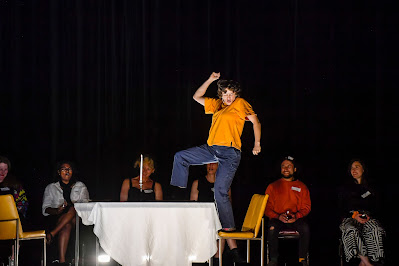
Grand Theft Theatre (which was originally commissioned and performed for Melbourne Fringe in 2022) is both a homage to and playful deconstruction of these various dualities. Over the space of an hour and 55 minutes (broken up by three 6-minute intervals), the five members of Melbourne-based collective Pony Cam and collaborator David Williams (former founder of version 1.0 and now artistic director of Alternative Facts) remember and re-enact moments from performances they’ve seen that have had a formative impact on them as audience-members and artists. 


Their memories are necessarily partial and unreliable; the re-enactments even more so. There’s much clowning and lo-fi staging, as well as impressive displays of physical skill, moments of pathos and images of beauty (and occasional horror). The show is as much about the failure of representation as it is about the works themselves.


On arrival, audience-members are asked to write their own favourite shows on sticky labels; these become talking-points with fellow audience-members during each of the intervals. This generates a sense of appropriately ephemeral community not only amongst the audience but between the audience and the performers. 


The community hall setting adds to this non-hierarchical ambience, as does the minimalism and deliberate messiness of the staging. We’re asked to position our own individual plastic chairs (each of which has the name of a well-known or lesser-known theatre-maker attached to it, also written on a sticky label) wherever we choose in the space; these are then moved into new configurations by the performers during each of the intervals. Props, lighting and sound cues are minimal and functional. The performers wear rehearsal clothes (which get progressively more stained during the show); the set is the space itself. 


The aesthetics and underlying politics of the work and its makers are influenced by similarly collaborative experimental ‘post-dramatic’ theatre groups like the UK’s Forced Entertainment (whose work is ‘remembered’ by Williams during the performance) or the British-German collective Gob Squad (whose influence is acknowledged in the program). However, you don’t need to be ‘in the know’ about these (or other) theatrical or artistic references to enjoy the show. The overall approach is light-hearted and (in every sense) accessible; as such it also belongs to a more specifically Australian ‘larrikin’ tradition of comedy, circus and physical theatre.


Like the material that’s being remembered and re-enacted (which ranges from high-art to popular, mainstage to fringe, international to local) there are high-points and longueurs; no doubt everyone in the audience responded to different sections in different ways (as my conversations with strangers about their own favourite shows during the intervals would seem to suggest).


The concept is so rich I found myself wishing for more diversity in the age of the performers (who are mostly in their twenties, except for Williams, who I would guess is in his forties) and the era in which they had most of their formative theatrical experiences (the early 2000s). I also couldn’t help wondering if some of the audience’s favourite theatre memories couldn’t have been communally shared and then spontaneously re-enacted by the performers as well, to broaden the range and break down the hierarchy between performers and audience even further.


In the end, there’s something beautiful about the evanescence of theatre and performance, as well as the unrepeatability of all experience, and even the unreliability of language and memory. This sense of beauty lingers after the show is over, in all its imperfections – like life itself. 


In the words of the Elvis song that ends the show and aptly describes all our favourite theatre memories: ‘Love me tender, love me sweet, never let me go. / You have made my life complete, and I love you so.’


*


Wolfgang von Flügelhorn is a writer and critic based in Perth, Western Australia. He was born in Flügelhorn, a small town in Upper Austria, in 1963. After finishing his undergraduate studies at the University of Lower Flügelhorn he completed his doctoral thesis at Cambridge on the later Wittgenstein and the phenomenology of language games (Der später Wittgenstein und die Phänomenologie den Sprachspielen, unpublished) under the supervision of Wittgenstein’s literary executor Elizabeth Anscombe, whose famous paper ‘The First Person’ argues that the pronoun ‘I’ does not refer to anything. On returning to Austria he was the lead vocalist and flugelhorn player in Viennese prog-rock/jazz-fusion band The Flaming Squirrels (Die Flammende Eichhörnchen). He left Austria and went into voluntary exile in 2000 after the formation of the far-right coalition federal government, vowing never to return. 


Professor von Flügelhorn is currently editor of the Zeitschrift für Unsozialforschung (Journal of Anti-Social Research) and Emeritus Professor at the University of Lower Flügelhorn where he holds a chair (remotely) in Paranormal Phenomenology while engaging his core muscles for two minutes every day. He is also the author of several monographs including Unlogische Untersuchungen (Illogical Investigations), Unzeitlich Sein (Not Being On Time) and Wahnsinn und Methode (Madness and Method), all of which have been translated into English by his friend and colleague Humphrey Bower but none of which has yet been published in any language.  


Sunday, 3 March 2024

The 4 Elements
Brooklyn Rider
Perth Concert Hall
Perth Festival


Angelique Kidjo
Perth Concert Hall
Perth Festival


Reviewed by Wolfgang von Flügelhorn


*


New-York-based string quartet Brooklyn Rider was founded in the early 2000s and loosely named themselves after the Munich-based Blue Rider group of early modernist painters. Comparisons with the Kronos Quartet inevitably suggest themselves: both ensembles practice cross-genre programming, focussing on contemporary and commissioned compositions from around the world in a variety of musical traditions, and juxtaposing these with more established works (mostly but not exclusively from the 20th Century). Kronos however are arguably cooler and more cerebral in terms of playing style; Brooklyn Rider have a warmer, more emotional approach. Unlike Kronos and most other string quartets, they also play standing up (apart from the cellist), which gives their performances an added sense of energy and embodiment.


Perhaps most significantly, however, their programming is based on extra-musical ‘themes’. The title of their current touring program refers to the ancient doctrine of the four elements that compose the natural world: earth, water, air and fire. A more specific contemporary reference (at least in the program notes) is to the theme of climate change, insofar as this has an impact on all four elements: parched earth, rising seas, storms and wildfires.


The concert began with a work in the category of ‘earth’: A Short While To Be Here, an arrangement by one of the quartet’s violinists, Colin Jacobsen, of a suite of North American folksongs collected by the pioneering American modernist composer Ruth Crawford Seeger. The title refers to the plaintive words of one of the folksongs: ‘Little Birdie, little birdie, come and sing me your song; / I’ve short time to be here, and a long time to be gone.’ The work was an exquisite reframing of the songs, their simplicity and innocence preserved notwithstanding the addition of more contemporary harmonies and textures, and the fact that they were linked together by more improvisatory-sounding musical connective tissue.


The next two short works in the program were new commissions – respectively in the categories of ‘fire’ and ‘air’ – and both were more clearly ‘programmatic’ in terms of their musical language. Massachusetts-born composer Akshaya Avril Tucker’s Hollow Flame is a response to the Californian wildfires of recent years, using sustained and hushed harmonics to suggest the inhalation of oxygen and exhalation of carbon that successively precedes and follows a massive conflagration; Portuguese composer Andreia Pinto Correa’s Aere senza stelle (‘Air Without Stars’) depicted the phenomenon of dust-storms using shimmering clouds of musical particles. Though short in duration and slight in terms of musical form, both works showcased the technical brilliance and flair of the players, as well as their capacity to listen closely to each other, and in turn inspire close listening from the audience.


This was followed by another (and more substantial) work of ‘air’ from the 1970s, French composer Henri Dutilleux’s Ainsi la nuit (‘Thus The Night’), a demanding work in seven movements (played without a break). Each movement plays with different sound qualities (harmonics, pizzicatos, extreme contrasts in dynamics or pitch) and uses atonality as well as unfamiliar scales or modes and recurring themes in various stages of development to compel the listener’s attention and play with their sense of memory and anticipation. This for me was musically speaking the most rewarding work in the first half of the concert (if not the entire evening) and took the quartet to another level in terms of precision and acuity. 


After interval came another more substantial 20th Century work of 'fire', Shostakovich’s 8th String Quartet. Written in the space of three days while the composer was visiting the fire-bombed city of Dresden in 1960, and dedicated ‘to the victims of fascism and war’, the work (like much of Shostakovich’s output) also has deeply personal resonances; legend has it that he was contemplating suicide at the time, and that when the Borodin Quartet first played it to him in private, he buried his face in his hands and wept. 


Musically this sense of personal significance is conveyed by the use of the composer’s signature four-note motif – which in its German notation (DSCH) corresponds to the first four letters of Shostakovich’s name in its German transliteration – as the opening theme as well as in every subsequent movement. Other quotations from his oeuvre (including the 1st Cello Concerto) are scattered throughout the work – all of which might seem to suggest that it was intended to be a kind of musical summation or epitaph.


It was given an appropriately fiery performance by the quartet, who rose to a new level of physical and emotional commitment. This was especially true of violinist Johnny Gandelsman (here playing 1st Violin, a role in which he and Jacobsen took turns during the concert); his heartfelt approach to the score (which often pits him as a lone voice against the combined forces of the other three) conveyed a sense of the individual crushed by totalitarianism.


The final work on the program – ostensibly in the element of 'water' – was Argentinian-born, US-based Romanian Jewish composer Osvaldo Golijov’s Tenebrae. As the liturgical title suggests, it’s a spiritual work of lamentation that recalls the neo-modal ‘holy minimalism’ of Gorecki’s ‘Symphony of Sorrowful Songs’ (the main theme is almost directly lifted from the second movement of that work). Golijov claims that he was inspired by two contrasting experiences in the year 2000: witnessing the violence in Israel-Palestine at the start of the Second Intifada; and seeing the Earth as if viewed from space at a planetarium in New York. 


The work opens and closes peacefully with the main theme repeated and developed over an oscillating drone (suggestive of the view of the Earth from space); the central section however is more fraught with pain, as if conflict becomes more evident as one approaches the Earth more closely. Musically if not thematically the work verges on sentimentality, but in the sensitive hands of the quartet – accentuating the flowing, undulating qualities of the main theme and the ostinato drone – it was a beautifully effective way to close the program. 


*


Beninese-French singer-songwriter Angelique Kidjo is a true force of nature. Now in her early 60s, her voice is as thrilling and percussive as ever, her dancing as energetic and playful, her enthusiasm as infectious, and her message of empowerment as resounding.


In her concert at Perth Concert Hall last Thursday night, she was the embodiment of this year’s Festival theme of Ngaangk (the sun), a female deity in Noongar cosmology who is equally a source of warmth, light, nourishment and protection. Despite the somewhat formal ambience of the venue, by midway through the concert she had us all on our feet dancing and singing along, sometimes in Fon or Yoruba (Kidjo sings in multiple West African and other languages, including French and English).


Local Noongar singer-songwriter Maatakitj (alias Clint Bracknell) kicked off the evening with a half-hour set featuring his own brand of desert blues in a series of songs in Noongar language about country, animals, spirits and waterways. He was backed by fellow Noongar artists Della Rae Morrison and Kylie Bracknell (who also provided intros to the songs and encouraged the audience to clap along or click our fingers to mimic the sound of rain). Perth-based percussionist Arunachala played an impressively huge pumpkin drum and provided drive and texture to the sound.


After interval, Kidjo erupted onstage, accompanied by a lean but seasoned four-piece band featuring Thierry Vaton on keys, David Donatien on percussion, Gregory Louis on drums and Gregory Louis (outstanding) on bass (the latter featuring plenty of slapping and sliding as well as some chunky melody-lines). Personally, I found the overall mix a bit bland, and would have welcomed a guitar or even a flugelhorn to give things more colour, but this was more than compensated for by Kidjo’s voice, dancing and irresistible charisma.


They opened with a hard-driven version of the Talking Heads classic ‘Cross-Eyed And Painless’ from that band’s seminal Afro-beat-based album Remain In Light (which Kidjo recently returned to its African roots in a reimagined track-by-track cover-album of her own). Another song from that album later in the set was ‘Letting The Days Go By’, which in keeping with Kidjo’s predominantly up-beat style felt a lot more light-hearted than the darker, more neurotic and surreal David Byrne original.


Songs from her recent album Mother Nature included the title-track, a reggae-based call to action in response to climate change; the joyous ode to the mother continent, ‘Africa, One Of A Kind’; the stirring summons to gender-based solidarity, ‘Choose Love’ (‘Brothers, why are we fighting each other? Sisters, why do we let the men take our power? Let’s be stronger than our fathers!’); the lilting song of encouragement to African self-reliance ‘Do Yourself’; the tighter, bouncier ‘Free and Equal’, juxtaposing words from the US Declaration of Independence and the UN Declaration of Human Rights with the realities of racial injustice highlighted by Black Lives Matter; the seductive dance number ‘Take It Or Leave It’; and the universalist love song ‘Meant for Me’ (‘I don’t care if you’re rich or poor, I don’t know what’s your DNA, I don’t care if your beauty fades, all I know is you’re meant for me’), which had the audience loudly echoing the refrain.


Kidjo also paid tribute to the Cuban ‘Queen of Salsa’ Celia Cruz with a sizzling rendition of ‘Bemba Colora’, followed by the slower, more sultry ‘Sahara’ (both sung in Spanish), after sharing a story about being inspired when she was a schoolgirl by seeing Cruz – the first woman she had ever witnessed singing salsa – on tour in Zaire in the 1970s. Later, she delivered a high-energy version of Afro-pop classic ‘Pata Pata’ by another of her role models, the pioneering South African singer and activist Miriam Makeba. Other songs from her own back-catalogue included the rousing hymn to Mother Earth ‘Agolo’ (which brought any remaining stragglers to their feet); and the Afro-Brazilian anthem ‘Afirika’ (which once again had us singing along to the refrain: ‘Ashé é Maman, ashè é Maman Afirika!’). 


Encores included a further medley of earlier career hits ‘We We’, ‘Batonga’ and ‘Adouma’, followed by a final speech decrying hatred and racism, before closing with another Afro-pop anthem to solidarity ‘Flying High’ (‘One love, one world, we have to live together’). All in all, it was a night of joy and hope, pride and defiance, and perhaps even a little anger and impatience with the world.


*


Wolfgang von Flügelhorn is a writer and critic based in Perth, Western Australia. He was born in Flügelhorn, a small town in Upper Austria, in 1963. 


After finishing his undergraduate studies at the University of Lower Flügelhorn he completed his doctoral thesis at Cambridge on the later Wittgenstein and the phenomenology of language games (Der später Wittgenstein und die Phänomenologie den Sprachspielen, unpublished) under the supervision of Wittgenstein’s literary executor Elizabeth Anscombe, whose famous paper ‘The First Person’ argues that the pronoun ‘I’ does not refer to anything. On returning to Austria he was the lead vocalist and flugelhorn player in Viennese prog-rock/jazz-fusion band The Flaming Squirrels (Die Flammende Eichhörnchen). He left Austria and went into voluntary exile in 2000 after the formation of the far-right coalition federal government, vowing never to return. 


Professor von Flügelhorn is currently editor of the Zeitschrift für Unsozialforschung (Journal of Anti-Social Research) and Emeritus Professor at the University of Lower Flügelhorn where he holds a chair (remotely) in Paranormal Phenomenology while engaging his core muscles for two minutes every day. He is also the author of several monographs including Unlogische Untersuchungen (Illogical Investigations),Unzeitlich Sein (Not Being On Time) and Wahnsinn und Methode (Madness and Method), all of which have been translated into English by his friend and colleague Humphrey Bower but none of which has yet been published in any language.  


Monday, 26 February 2024


Are we not drawn onward to new erA
Ontroerend Goed
Perth Festival
Heath Ledger Theatre
 
Logue Lake
Written by Geordie Crawley and directed by Elise Wilson
Perth Festival
Studio Underground


Reviewed by Wolfgang von Flügelhorn


Hegel wrote that ‘the owl of Minerva spreads her wings at dusk’ – meaning that historical understanding only takes place when a particular era or ‘shape of life’ has ‘grown old’. Kierkegaard gave this an existential twist when he wrote that ‘life must be lived forwards, but it can only be understood backwards’. For Marx, more pithily, ‘history repeats itself, the first time as tragedy, the second time as farce’. 


All three sayings apply to Belgian contemporary performance group Ontroerend Goed’s concept-driven and image-based work Are we not drawn onward to new erA, which challenged and divided audiences at Perth Festival last week.


In fact, it’s difficult to write about the work in other than abstract terms without spoiling it for those who might one day see it. This is because it depends on what’s called in theatre parlance a ‘reveal’, which occurs at a turning-point (or more precisely, given the content of the work, a tipping-point) halfway through. However, prior to that (depending on the perspicacity of the viewer) there’s a sudden (or dawning) realisation about the apparent senselessness of what’s being said and done onstage (as well as the apparent senselessness of what we as a species are doing to the planet).


The opening image (no spoiler here) is of a bare stage apart from a single tree standing in a mound of earth and a woman lying on the floor with her back to us. She’s in contemporary clothes, but the image is already mythical, even Biblical (the tree bears a single apple). Soon she wakes up, heads downstage, and speaks in a mysterious language. Shortly afterwards she’s joined by others – and by an increasingly mysterious accumulation of other objects, to which increasingly mysterious things are done.


Perhaps paradoxically (given its palindromic title) Are we not drawn onward to new erA is fundamentally about irreversibility. As Lady Macbeth says: ‘What’s done cannot be undone.’ In this show, the reverse turns out to be true – at least with the help of a certain technological trickery (which I won’t reveal here). However, despite its cleverness (which at times makes us want to laugh or clap), this trickery only underscores its own deceptiveness. Any elation we feel is followed by sadness, because of the fundamental impossibility of what we are witnessing; we might laugh and clap, but (inwardly at least) we also weep.


What German aesthetics refers to as the ‘beautiful appearance’ or ‘beautiful illusion’ (schöne Schein) of art is, precisely, an appearance or illusion only – one that, according to Schiller, acknowledges its own unreality. For Adorno, writing at the tail-end of this tradition, all art is sad – not only because of the transitory nature of its illusions, but because it shows us (and here Adorno quotes Beckett) both ‘how it is’ and ‘how things are’ (‘comment c’est’).


In showing us ‘how it is’ as well as ‘how things are’ in its form and content – which are perfectly matched and rigorously followed-through – Are we not drawn is a more sophisticated work than the two other shows I’ve seen in this Festival that deal with ecological crisis. The sentimentality and anthropocentrism of The Jungle Book Reimagined (‘man-cub saves the world’) or the fatalism and misanthropy of Food (‘man eats the world’) are here surpassed by a meta-theatrical reflection on the use of technology in live performance. 


To be sure, as in Food, there’s an acknowledgement that (as a species and as individuals) ‘we need to leave’ (this planet, this life). However, this recognition is humbler (and more modestly executed) than the former show’s final act of self-burial. Instead, there’s a sense in Are we not drawn that we must do what we can to ‘reverse’ things; but also that, from a cosmic perspective, ‘all things must pass’, including ourselves.


Finally, the themes of irreversibility, illusions, transience, and the melancholy sense of ‘how things are’ also appear in what might be called the ‘relationship plot’ of the work. This concerns our relationships with each other – including love, as well as an acknowledgement of love’s inevitable failure. In this regard, it’s surely no accident that (to my ears at least) the first (comprehensible) word spoken in the show is ‘eros’ – and the last, ‘sorry’.


*


There’s something of a craze at the moment for ‘immersive’ theatre that plays with the audience’s relationship with the actors and the physical space. Perhaps this has something to do with the impact of film, TV and more recently streaming (accelerated by the pandemic) on our capacity to focus on and contemplate action collectively or from a fixed point of view; instead, we’ve become accustomed to the intervention of cameras and editing techniques that zoom in and out, pan, cut, dissolve and reframe what we’re watching; not to mention changing channels, getting up and moving around, or interrupting at will our increasingly personalised and even privatised ‘viewing-experience’. There are arguably sociological as well as technological reasons for this development; one might even posit that contemporary capitalism and neoliberalism have led to increasingly individualised and atomised forms of cultural production and consumption. Alternatively, one might simply argue that there’s more than one way to watch a show.


In many ways the experience of seeing Logue Lake resembles both watching a film (or even being on a film set) and viewing a visual art installation. We’re free to wander around the set and action (as long as we don’t interact with the actors – ‘no touching or talking’ is the general rule – or enter the house without walls or roof that sits in the centre of the space) and can also head upstairs for an overview from the gallery seats. Crucially, we’re equipped with headphones (a device which is also used in two other Festival show this year, The Pool and The Invisible Opera) and handheld radios, and are free to switch between five audio channels, each of which represents one of the characters’ subjective points of view (including dialogue, music and internal monologue), regardless of where we are in the space or what we happen to be watching. 


It’s impossible to take in the entire show, as scenes are occurring simultaneously in different parts of the set. I spent the first ten to fifteen minutes upstairs in the gallery, which gave me a ‘wide-shot’ (so to speak) of the whole space (including most of the audience who were moving around the set at floor-level); but found myself occasionally changing audio channels so as to pick out different scenes. Then I moved downstairs and spent the rest of the play circling the action and sitting at various points along the way, while changing channels in order to hear whatever scene I was watching. 


Sometimes I chose a particular character and followed them; at other times something in my peripheral vision attracted my attention and I allowed it to lead me. At times I felt like a camera or boom operator choosing my own ‘angle’ on things; at other times I felt more like an editor, assembling my own ‘cut’. In general, I noticed that the dialogue scenes drew my attention more strongly; I found myself less intrigued by the interior monologues, perhaps because I felt that I didn’t really need to hear the character’s thoughts or see the characters having them (possibly this wouldn’t have been the case had I been watching a film). 


Unlike the immersive dance theatre show Sleep No More, Logue Lake is narrative-driven, and the action takes place in a single location and unfolds in real time. Essentially, it’s an outback Australian Gothic horror movie (interestingly, Malthouse Theatre’s immersive, headphone-based, narrative-driven Hour of the Wolflast year was in a similar vein). 


Four friends in their twenties or thirties spend the night in a cabin by a lake that has a demonic legend attached to it; a mysterious fifth character shows up, who seems to have a connection with the legend; mayhem ensues. Other familiar horror tropes include the figure of the double (echoing another Festival show inspired by genre-movies, Stunt Double, but in this case harking back to films like The Invasion of the Body Snatchers or John Carpenter’s The Thing); one scene involving a knife-wielding cross-dresser recalls Psycho or Dressed To Kill. 


I wasn’t entirely clear as to whether these and other motifs – or the intermittently ‘spooky’ soundtrack – were meant to scare us (an effect which is notoriously difficult to achieve in theatre as opposed to film) or invite us not to take things too seriously (or perhaps both). I felt something similar about the occasionally clunky dialogue, which would have been unexceptionable in a horror movie, but sometimes sounded a little awkward onstage (I felt a similar tonal ambiguity and occasional awkwardness in The Hour of the Wolf at Malthouse).


In fact, a certain ‘queering’ of the narrative and (at least potentially) the overall form of the work is potentially one of the script’s more original strengths and could have been pushed further; but I sensed a certain ambivalence about pursuing this stylistically. Perhaps this was connected to the use of headphones and body-mics, and the related attempt to achieve the effect of naturalistic ‘film-acting’ onstage (again, I sensed a similar ambivalence and tendency towards naturalism in The Hour of the Wolf).


Notwithstanding these reservations, Logue Lake is an enjoyable evening of fun and games, with some more thoughtful provocations about the effects of internalised homophobia and denial on the Australian psyche. The sound design by Ben Collins and Chloe McCormack is a technical tour de force; Samuel Diamond’s production design and Peter Young’s lighting are beautifully judged and evocative, especially given the challenges of the immersive staging. Performers Isaac Diamond, Timothy Green, Lila McGuire, Will O’Mahony and Alicia Osyka navigate the (sometimes conflicting) demands of the script and staging with admirable skill and integrity, especially given the consummate timing involved in moving around the set from one overlapping scene to the next. 


Abiding questions remain. What do we gain (and what do we lose) by staging this story in this particular way – as opposed to watching a horror film, or even seeing things play out onstage in sequence, one scene at a time? And conversely: why choose this particular genre in order to explore the form of immersive theatre itself? Is the latter even really suited to narrative-driven theatre at all?


*


Wolfgang von Flügelhorn is a writer and critic based in Perth, Western Australia. He was born in Flügelhorn, a small town in Upper Austria, in 1963. After finishing his undergraduate studies at the University of Lower Flügelhorn he completed his doctoral thesis at Cambridge on the later Wittgenstein and the phenomenology of language games (Der später Wittgenstein und die Phänomenologie den Sprachspielen, unpublished) under the supervision of Wittgenstein’s literary executor Elizabeth Anscombe, whose famous paper ‘The First Person’ argues that the pronoun ‘I’ does not refer to anything. On returning to Austria he was the lead vocalist in Viennese prog-rock/jazz-fusion band The Flaming Squirrels (Die Flammende= Eichhörnchen). He left Austria and went into voluntary exile in 2000 after the formation of the far-right coalition federal government, vowing never to return. 


Professor von Flügelhorn is currently editor of the Zeitschrift für Unsozialforschung (Journal of Anti-Social Research) and Emeritus Professor at the University of Lower Flügelhorn where he holds a chair (remotely) in Paranormal Phenomenology while engaging his core muscles for two minutes every day. He is also the author of several monographs including Unlogische Untersuchungen (Illogical Investigations),Unzeitlich Sein (Not Being On Time) and Wahnsinn und Methode (Madness and Method), all of which have been translated into English by his friend and colleague Humphrey Bower but none of which has yet been published in any language.  


Friday, 23 February 2024

Food

Geoff Sobelle
His Majesty’s Theatre
Perth Festival

Reviewed by Wolfgang von Flügelhorn


New-York-based performance-maker Geoff Sobelle’s Food masquerades as an absurdist audience-interactive clown show but gradually reveals a more ominous (not to say omnivorous) intent – as foreshadowed by the sombre 19th century hunting painting that hangs on the upstage wall of the set.


It’s being staged for Perth Festival in the appropriately Edwardian-Baroque ambience of His Majesty’s Theatre – appropriate because the show itself becomes increasingly baroque in form and mood. The audience is seated onstage around three sides of a huge table covered with a white tablecloth. Selected audience members sit at the table and are served wine and food as well as being asked to make various other contributions during the show; the rest of us are on three banks of seating behind them and are also occasionally asked to pour wine or perform other tasks.


Sobelle plays the role of our host and head waiter, dressed in white shirtsleeves and black waistcoat, pants and shoes. His persona is initially relaxed and affable if a little aloof as he chats with the audience, gives instructions and serves his ‘guests’. 


An initial guided meditation on the evolution of life on earth from the perspective of eating and food is followed by an audience-participation sequence using wine-tasting as a jumping-off point for shared memories, which creates a sense of community and intimacy. The distribution of menus, taking of orders and delivery of food ‘from farm to table’ leads to an escalating sequence of comic routines, including the disinterring of a baked potato seeded and watered in a pile of earth, and the retrieval of a ‘live’ Arctic char from beneath the surface of the tablecloth, which has been transformed by the lighting design into a frozen sea.


About half an hour into the show Sobelle sits down, begins eating an apple, removes his shoes and falls silent; the veneer of affability falls away, and the tone and form of the work changes radically. An extended sequence (reminiscent of Marco Ferreri’s 1973 film La Grande Bouffe) follows in which Sobelle devours the leftovers from the audience’s meals in an impossible feat of gluttony (involving some deftly executed sleight-of-hand) that includes smoking and eating a packet of cigarettes (which are swallowed while still alight) as well as consuming a box of matches, a mobile phone, a pile of napkins and two bottles of wine. 


In short: we’re now firmly in the realm of the grotesque – as well as an increasingly (and deliberately) heavy-handed satire on consumerism. This soon gives way to an even more extended sequence on the theme of ecological destruction (placing Food in conversation with two other works in this year’s Perth Festival, The Jungle Book Reimagined and Are we not drawn onward to new erA). 


A now-dishevelled, food-and-wine-stained Sobelle drags the tablecloth away to reveal a landscape of parched earth, crawls onto it and carefully manoeuvres a miniature herd of toy bison across the plain before returning them to the dust from whence they came (for me this was the most moving image of the entire show). Stalks of wheat sprout mechanically from the dirt, and a new ‘herd’ of toy agricultural and extractive machinery is unleashed across the depleted landscape, including diggers, trucks and eventually oil-cranes (after Sobell plunges his arm into the earth and pulls it out again covered with thick black liquid). Toy buildings sprout from the dirt like weeds, and the audience is encouraged to place other toy structures and dwellings around the edge of the landscape. 


In the closing section of the work, an audience-member recites a litany of foodstuffs that have been hunted, gathered, farmed, engineered or manufactured throughout history, while Sobell stands behind them and touches the back of her head as if in an act of telepathic dictation (I for one couldn’t see how this particular magic act was done). Finally, he digs a pit in the centre of the table, lowers himself into it and disappears in an act of self-burial, as if on behalf of our entire species.  


Sobell’s performance is exquisitely judged and impeccably skilled as he moves from clowning and magic (the show is co-created by magician Steve Cuiffo) to more ambiguous, less easily digested (if you’ll pardon the pun) forms of movement-based image-making. Co-director Lee Sunday Evans keeps things smoothly flowing and changing; Isabella Byrd and Devin Cameron’s lighting gently leads us from the simplicity of the initial conceit (an evenly lit restaurant, a fake candle) to increasingly heightened states of theatricality; Tei Blow and Tyler Kieffer’s subtle and detailed sound design almost imperceptibly transports us from the here-and-now to ever-more expansive circles of attention and concern.


On the night I attended the audience seemed noisily determined to enjoy the show on their own terms and were perhaps less comfortable with the shift from audience participation, clowning and magic to the darker realms of misanthropic social satire and ecological critique. For my part, I felt that the work was somewhat disjointed and even unclear in terms of its overall form and intention, and that the audience's restlessness to some extent reflected this. I enjoyed the level of agency and freedom that we were given in the opening section, especially in the sharing of stories; in the central section, however, we became silent witnesses; and in the closing section, the participants were effectively puppets or automatons, mindlessly obeying instructions or repeating lists of words.


Somehow, in the face of consumer capitalism and the environmental crisis that afflicts us, we need to be given a sense of agency and empowerment. Otherwise we’re merely cogs in a machine, or worse, the mindless agents of our own destruction.


*

Wolfgang von Flügelhorn is a writer and critic living in Perth, Western Australia. He was born in Flügelhorn, a small town in Upper Austria, in 1963. 

After finishing his undergraduate studies at the University of Lower Flügelhorn he completed his doctoral thesis at Cambridge on the later Wittgenstein and the phenomenology of language games (Der später Wittgenstein und die Phänomenologie den Sprachspielen, unpublished) under the supervision of Wittgenstein’s literary executor Elizabeth Anscombe, whose famous paper ‘The First Person’ argues that the pronoun ‘I’ does not refer to anything. He left Austria and went into voluntary exile in 2000 after the formation of the far-right coalition federal government, vowing never to return. 

Professor von Flügelhorn is currently editor of the Zeitschrift für Unsozialforschung (Journal of Anti-Social Research) and Emeritus Professor at the University of Lower Flügelhorn where he holds a chair (remotely) in Paranormal Phenomenology while engaging his core muscles for two minutes every day. He is also the author of several monographs including Unlogische Untersuchungen (Illogical Investigations), Unzeitlich Sein (Not Being On Time) and Wahnsinn und Methode (Madness and Method), all of which have been translated into English by his friend and colleague Humphrey Bower but none of which has yet been published in any language.  


Monday, 19 February 2024

Stunt Double

The Farm
Studio Underground
Perth Festival

Reviewed by Wolfgang von Flügelhorn


The 1970s are often celebrated as a golden age of liberation and progress in Australia; the Whitlam era in particular is viewed as a time when the nation came of age. However, there’s also a darker side to the 70s, as the underlying power-dynamics of capitalism and sexism (not to mention racism) remained fundamentally intact, especially in the entertainment industry. Low-paid workers, women and people of colour were exploited; producers, directors and stars abused their power.


These contradictions are explored in Stunt Double, the latest offering from The Farm, a collaborative dance theatre/contemporary performance company based on the Gold Coast. Core members Gavin Webber (writer, performer), Grayson Millwood (performer), Kate Harman (performer) and Chloe Ogilvy (lighting designer) developed the show in conversation with stunt performers about their experiences working in the film industry.


The loose narrative framework is set on the shoot of a 70s Ozploitation film called Don’t Wake The Dark (in obvious allusion to Wake In Fright, which arguably launched the genre). Patrick Paterson (Webber) is a safari-suited action-hero past his prime; sharing the screen with him (and barely tolerating his off-screen advances) is emerging star Maureen O’Sullivan (Harman). Meanwhile their stunt-doubles (David Carberry and Alex Kay) do most of the work in the shooting of the action sequences – although Paterson and O’Sullivan become increasingly competitive with them, insist on doing more and more of their own stunts, and eventually become locked in rivalry with their counterparts.


Other characters include the film’s manipulative director (Millwood – though on the night I saw the show his role was played by Matt Cornell); an eager-beaver cameraman who is also the show’s announcer (a role normally played by Cornell, who on this occasion was replaced by Nathan Kell); and an exasperated Assistant Director (Ngoc Phan) doing her best to keep things on-schedule. The roles of other crew members and extras are played by pre-selected audience volunteers, who are given instructions by the AD during the show, which adds an extra layer of comedy and spontaneity, as well as underlining (and to some extent subverting) the hierarchies typically operative during a film-shoot.


The ‘on-set’ scenes are wildly entertaining and have an appropriately B-movie feel. A fight-sequence in an outback pub (with the audience volunteers as extras) involves elaborate stunts and mid-shot substitutions between Paterson and his double; an attack on a group of picnickers by a pack of mutant dingoes (all played by the audience volunteers) leads to one of the dingoes (played by Paterson’s double) mauling O’Sullivan’s character before being viciously beaten to death by Paterson with a cricket bat. 


Other scenes use a more abstract contemporary-dance movement vocabulary (with perhaps an over-reliance on slow motion and mirroring), and have a more surreal quality reminiscent of David Lynch (in particular Twin Peaks and Mulholland Drive) – a resemblance heightened by Ogilvie’s noirish lighting and ominous music by sound designer and composer Luke Smiles (in contrast with the bright film lights, adrenaline-fuelled Oz rock classics and exaggerated sound effects that accompany the fight-sequences). This layer of the show explores the psychological aspect of doubling and doppelgängers (most famously analysed by Freud in his essay on ‘The Uncanny’); a haunting sequence involves multiple reduplications of O’Sullivan and her double by audience volunteers wearing similar red dresses and wigs. 


The two layers of the show merge in a nightmarish and thrilling climactic action-sequence (recalling Tarantino’s Death Proof and the road/slasher-movies that inspired it) that involves the AD and O’Sullivan (or was it her double?) in a stripped-back car driving headlong through the desert (a theatrical/cinematic illusion created by the lighting and sound design), while the rest of cast (all wearing safari suits) hurl themselves at the vehicle and attack the driver and passenger. This sequence culminates in a shocking and spectacularly staged ‘accidental’ death on-set, which is effectively ‘covered up’ by an abruptly descending red curtain; after an Awards ceremony in front of the curtain in which the movie wins Best Film (with of course no mention of the stunt performers), the death-tableau is re-revealed by a final Kabuki drop.


With a crazed glint in his eye, Webber shines (if that’s the right word) as the grotesque Paterson, a role requiring star-charisma, clowning and dance/movement skills in equal measure. Tyler Hill’s generic costumes and minimalist interactive film-set design (based on original scenography by Zoe Atkinson) do their job effectively; sporadic video snippets from a cringingly awkward post-production interview with Paterson, O’Sullivan and the film director reveal in close-up the power dynamics and tensions we witness emerging on-set.  


Stunt Double isn’t simply a celebration or spoof of the Ozploitation genre (though it’s undeniably both of those things), but a Swiftian satire on the entertainment industry and the dark truths that are normally concealed behind the curtain of celebrity and glamour. It also shines a light on the (mostly uncredited) work of stunt-performers, and the level of exploitation and risk that (like most low-wage workers and women in the industry) they’re forced to endure. And finally, it points to the enduring contradictions and unfulfilled promises of the 1970s that still haunt us today.


*


Wolfgang von Flügelhorn is a writer and critic based in Perth, Western Australia, with a special interest in doubles and doppelgängers. He was born and raised in Flügelhorn, a small town in Upper Austria. After finishing his undergraduate studies at the University of Lower Flügelhorn he completed his doctoral thesis at Cambridge on the later Wittgenstein and the phenomenology of language games (Der später Wittgenstein und die Phänomenologie den Sprachspielen, unpublished) under the supervision of Wittgenstein’s literary executor Elizabeth Anscombe, whose famous paper ‘The First Person’ argues that the pronoun ‘I’ does not refer to anything. On returning to Austria he became the lead vocalist and flugelhorn player in Viennese prog-rock band The Flaming Squirrels (Die Flammende Eichhörnchen). He left Austria and went into voluntary exile in 2000 after the formation of the far-right coalition federal government, vowing never to return. 


Tuesday, 13 February 2024


The Jungle Book Reimagined

Akram Khan Company 
Perth Festival
Heath Ledger Theatre Theatre


Mutiara

Marrugeku
Perth Festival
Studio Underground


Artistic Director Iain Grandage’s fourth and final Perth Festival is entitled Nnaangk – the Nnoongar word for ‘sun’, a female deity associated with warmth, nurturing and healing. In this context the Akram KhanCompany’s Jungle Book Reimagined is a surprisingly dark and dystopian work – even though it’s described by Grandage in the program as being ‘created with family audiences in mind’.


Khan ‘reimagines’ Kipling’s collection of stories about an Indian boy raised by wolves as a cautionary tale set in a future ravaged by climate change. Mowgli (in this version, a young woman, played by Jan Mikaela Villanueva) is a climate refugee separated from her family during a storm at sea. She washes up in an abandoned city reclaimed by animals who’ve escaped from captivity. Baloo (Tom Davis-Dunn) is a former circus-bear; Bagheera (Holly Valis) is a domesticated panther raised in a palace; the bandar-log monkeys are the traumatized survivors of lab experiments; Kaa is an escaped python from a glass cage in the zoo. In a more significant reversal, the tiger Shere Khan is now a gun-toting human hunter who shoots animals on sight.


As in Kipling’s original, the animals conveniently talk to each other and Mowgli (who also understands and talks back to them) in English (a device which is somehow more jarring onstage than it was on the page). In Khan’s production, they’re played by a cast of ten dancers (Kaa is represented by a collection of cardboard boxes with glowing red eyes manipulated by a team of dancers), as well as appearing in beautiful line-drawn animations projected onto scrims across the front and back of the stage (the hunter Shere Khan is represented by an animated shadow). They’re also ‘voiced’ by a separate cast of actors in a pre-recorded soundtrack – a fatal misstep which for this reviewer kills the show, as it disconnects the dancers from the audience and makes us feel like we’re watching a kind of ‘live cartoon’.


There’s no denying the virtuosity of the cast, or the distinctiveness of Khan’s choreography, which draws on traditional Indian kathak as well as contemporary dance, predictably incorporating a lot of ‘animal’ work on all fours. However, the synchronised coordination of the dancer’s movements with the pre-recorded dialogue is reductive and over-literal; ironically it makes them less like animals, and more like humans using mime. 


The set design is relatively minimal (apart from the projection scrims), consisting of a bare stage and a few piles of cardboard boxes (which according to Khan in a program note demonstrates the show’s commitment to sustainability). On the other hand, the staging is heavily reliant on video and sound technology (including a Hollywood-style ‘exotic’ score by composer Jocelyn Pook). All of this swamps the work of the dancers, as well as being at odds with the overall message about reconnecting with the natural world. 


Harnessing Kipling’s stories and characters to the theme of climate change is a noble cause but reduces their complexity. As a result the show feels more like a work of Victorian moralising than the original. It also doesn’t address Kipling’s obsessions with abandonment and foster-families, colonialism and exile, and the contradictions between ‘the law’ and more ‘primordial’ impulses. Kipling's animals are not really animals at all, but human beings; Mowgli the 'man-cub' is arguably a representation of Kipling himself. 


All of this is brushed over in Khan’s ‘reimagining’ – ironically so, given the dancer/choreographer’s own cultural heritage as a British-Bangladeshi artist born in London, much of whose work has been preoccupied with his own conflicted sense of home and identity. His autobiographical solo show Desh, which came to the Melbourne Festival in 2012, remains the most powerful work of his I’ve seen. In comparison The Jungle Book Reimagined feels like a missed opportunity.  


*


Broome-based Indigenous intercultural dance theatre company Marrugeku’s Mutiara is more intimate and reflective than their previous production Jurrungu Ngan-ga (Straight Talk), an explosive large-scale work about the incarceration of Aboriginal people and asylum seekers. Nevertheless the two share a common focus on racialised violence and oppression as defining mechanisms of White Australia since colonisation. 


Mutiara (which means ‘pearl’ in Malay) deals with the history of pearling in Broome, from its Indigenous antecedents – when pearl shells were carved and worn or traded across the continent and the region – to its colonial expansion as a global industry in the 19th Century, when pearls were primarily used for the manufacture of buttons in Europe. This expansion involved the enslavement, forced labour and exploitation of Aboriginal, Malay and Japanese divers, all of whom were overworked and many of whom died from decompression sickness.


The four performers are also co-choreographers: Dalisa Pigram (who is also Marrugeku’s co-artistic director alongside Rachael Swain, the show’s dramaturg), Soutari Amin Farid (who is also its cultural dramaturg), Zee Zunur and Ahmat Bin Fadal (who is also an advisor on pearl diving history and Malay culture). Collectively they bring to the work a strong mix of choreographic traditions and practices including Indigenous and contemporary dance as well as the Malay martial art known as silat. 


All four also have strong cultural and geographical connections to the work: Pigram was born and raised in Broome and has a mixed Yawuru/Bardi and Malay/Filipino heritage; Farid, Zunur and Bin Fidal are Malay Singaporeans. Bin Fidal also has a more personal connection: th the work: now in his 80s, he emigrated to Broome in the 1960s and worked as a diver in Broome from the 1960s until he retired after a near-fatal accident while diving, and this experience is a central thread in the content of the work. 


The form is episodic and thematic rather than narrative-based. Certain sequences stand out: Zunur’s opening appearance as a quivering Bomoh (a Malay shaman-figure who acts as a kind of portal to the spirit world) with her hair hung forward in a curtain over her face; Pigram and Farid joyfully and lovingly partner-dancing to the popular music of the 1950s in defiance of regulations against interracial fraternisation; Farid doing an elegant fan-dance with two pearl shells; Bin Fidal performing an austere solo based on his sidat martial arts training; and most memorably Pigram doing a hauntingly expressive dance with spoken text invoking the fate of Aboriginal women who were kidnapped and enslaved (or ‘blackbirded’) in the 19thCentury and forced to dive as well as being used as sex slaves (many of these women were pregnant because it was falsely believed that this gave them greater lung capacity for diving).


At other times the choreography is less specific and seems to wander and lose focus, as if an over-reliance on task-based improvisation has led to simply maintaining and exploring various physical or emotional states. This impression is underscored by the over-use of dim, moody lighting and ambient or repetitive music tracks. The set design by visual artist Abdul-Rahman Abdullah – consisting of a downstage pile of pearl shells and an upstage curtain of ropes which hung from the lighting grid and were reminiscent of the riggings of pearl luggers or the signal-ropes to which divers were tethered, as well as resembling fronds of sea grass – also induces a certain visual monotony, notwithstanding the fact that the ropes are also used as a projection surface for black-and-white archival footage of the pearling industry as well as being variously manipulated by the performers. 


A sense of being in an underwater world is effectively evoked, but even when Bin Fidal moves around the space reading aloud in Arabic from invisible gravestones we never emerge from a realm of memory and reverie. Recorded voiceovers using stereotypical accents and featuring excerpts from archival texts of racialized pseudo-science or officialese add a further layer of horror but are clumsy in execution, and (like the archival video projections) reinforce the sense of being continually pulled out of the present moment and back into the past.


Mutiara covers important historical ground, features some deeply moving performances (especially from Pigram and Bin Fidal) and is grounded (like all of the company’s work) in the authenticity of the performers’ connection with the material. Nevertheless in comparison with Jurrungu Ngan-ga the work feels underdeveloped and lacking in direction. It’s as if the aura of nostalgic myth surrounding the pearling industry still hasn’t quite been dispelled, despite the history of violence lurking beneath its deceptively placid surface.  


*


Wolfgang von Flügelhorn is a writer and critic based in Perth, Western Australia. He was born and raised in Flügelhorn, a small town in Upper Austria, in 1963. After finishing his undergraduate studies at the University of Lower Flügelhorn he completed his doctoral thesis at Cambridge on the later Wittgenstein and the phenomenology of language games (Der später Wittgenstein und die Phänomenologie den Sprachspielen, unpublished) under the supervision of Wittgenstein’s literary executor Elizabeth Anscombe, whose famous paper ‘The First Person’ argues that the pronoun ‘I’ does not refer to anything. On returning to Austria he was the lead vocalist and flugelhorn player in Viennese prog-rock/jazz-fusion band The Flaming Squirrels (Die Flammende Eichhörnchen), in which capacity as the band’s front-man he developed a unique form of contemporary dance combining elements inspired by Isadora Duncan with the traditional Austrian Schuhplattler. He left Austria and went into voluntary exile in 2000 after the formation of the far-right coalition federal government, vowing never to return.